MedWet supports the Wetland City Accreditation at the Mediterranean level to promote the conservation and wise use of urban and peri-urban wetlands, as well as the socio-economic benefits for local communities.
To achieve this, MedWet undertakes the following actions:
- Establishing and coordinating a Mediterranean working group on the Wetland City Accreditation.
- Implementing information and awareness-raising activities on the accreditation for key stakeholders in the Mediterranean.
- Strengthening its online and physical presence at events related to the accreditation, such as mayoral roundtables.
This page describes the background, criteria and procedure for obtaining the “Wetland City Accreditation” of the Convention on Wetlands, a scheme adopted in 2015 during the 12th Meeting of the Conference of the Contracting Parties to the Convention (COP12), through Resolution XII.10.
About the scheme
“Wetland City Accreditation” is a voluntary scheme for subnational governments of the Contracting Parties to the Convention on Wetlands. This scheme provides an opportunity for cities with strong and positive links to wetlands to use the distinctive mark of accreditation.
The accreditation is valid for two COP cycles (six years). Cities that maintain compliance with the accreditation criteria may renew it, subject to evaluation by the Independent Advisory Committee (IAC).
Official documents on Wetland City Accreditation are available on the Convention’s website.
Why becoming a Wetland City is beneficial
Becoming a Wetland City brings a wide range of benefits — from boosting global recognition to enhancing urban sustainability. Below are some of the key advantages of this designation:
- Raise the profile of the city.
- Market green credentials by demonstrating that nature is considered in local planning and decision-making.
- Leverage funding opportunities.
- Inspire other cities.
- Join a global community of best practices.
- Create and maintain vital urban spaces.
- Enhance the well-being of all citizens.
- Strengthen the city’s commitment to sustainability, resilience, and well-being, prioritizing responsible management of wetlands.
- Raise the bar on delivering the wise use of wetlands.
Designated Wetland Cities since 2018
Summary of Wetland City Accreditation criteria
Cities must meet specific criteria to earn Wetland City status, including:
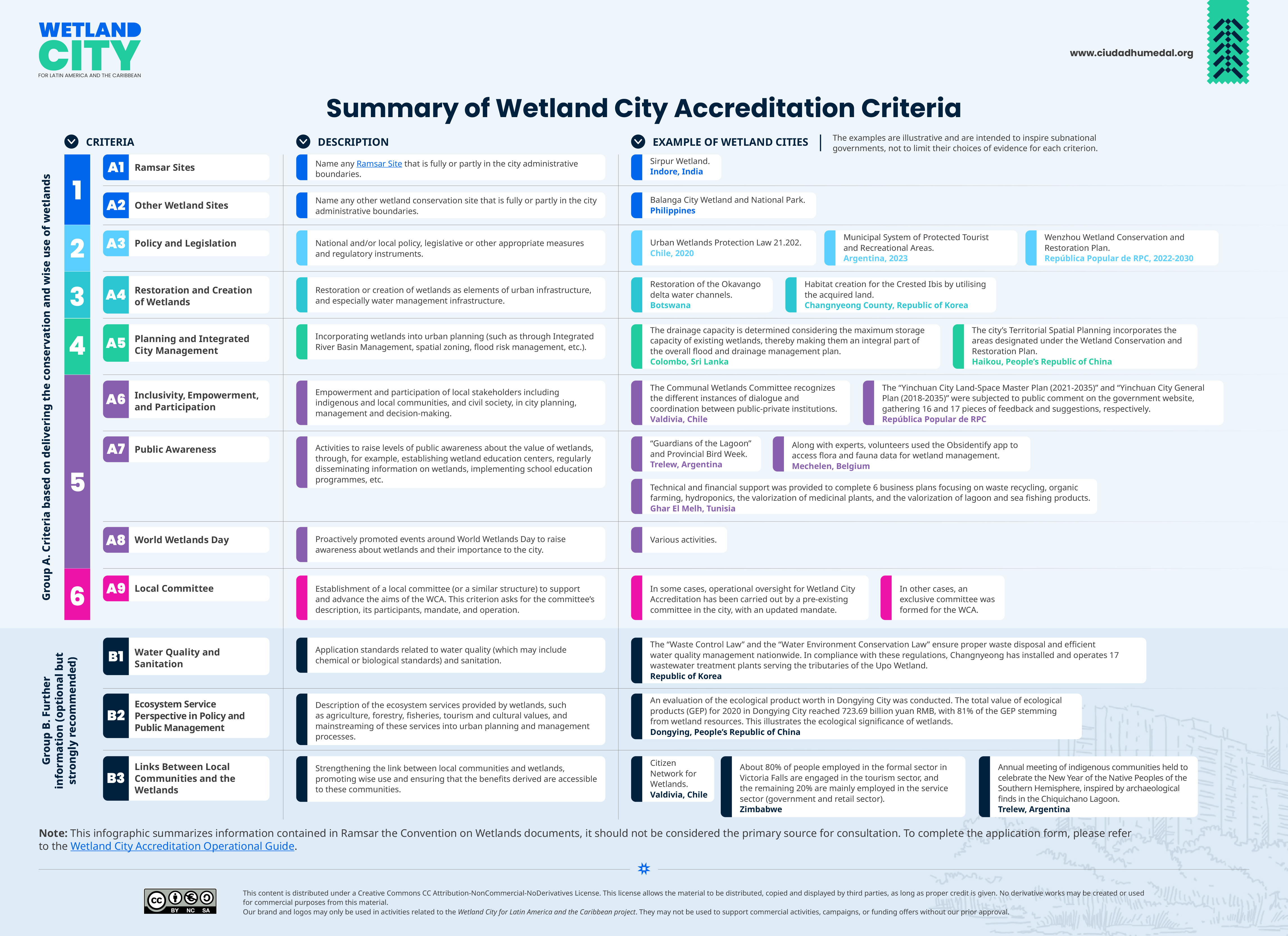
Source: ciudadhumedal.org
The high-resolution version of the photo is available here.
To complete the application form, please refer to the Wetland City Accreditation Operational Guide.
Wetland City Accreditation process
Year 0:
- During the Standing Committee (SC) meeting that immediately follows a COP, the SC nominates a representative from each region for the Independent Advisory Committee (IAC).
- A new IAC term begins with a work plan for the next triennium and the election of a Chair and Co-Chair.
Year 1:
- The Secretariat publishes a call for applications (within 6 months after each COP). The city completes and submits the nomination.
- The city completes and submits the nomination form.
- The National Administrative Authority (AA) for the Ramsar Convention reviews the form, requests adjustments if necessary, and endorses the application.
- The Secretariat receives the forms and checks for endorsement.
Year 2:
- The IAC reviews and selects applicant cities to be accredited.
Year 3:
- The SC takes note of the IAC report and ratifies it.
- The Secretariat publishes the list of newly accredited cities and invites them to the COP.
- During the COP, newly accredited Wetland Cities are awarded in an official ceremony.
Who reviews the applications for Wetland City Accreditation?
A candidate city for Wetland City Accreditation is approved as an accredited Wetland City by the Independent Advisory Committee (IAC) after being proposed by the Contracting Party on whose territory it stands and completing the accreditation procedure described in the Operational Guidance Annex.
The content of this page is based on “ Wetland City for Latin America and the Caribbean (LAC)”, a website that highlights the benefits of urban wetlands for people and biodiversity in the region.
More information
Operational Guidance:
https://www.ramsar.org/document/operational-guidance-wetland-city-accreditation-ramsar-convention-wetlands
Guidance Note for Ramsar Administrative Authorities:
https://www.ramsar.org/es/document/acreditacion-de-ciudad-de-humedal-nota-de-orientaciones-para-autoridades-administrativas
Guidance Note for Cities:
https://www.ramsar.org/es/document/acreditacion-de-ciudad-de-humedal-nota-de-orientaciones-para-ciudades
Contact
Sana Mezoughi, MedWet
mezoughi@medwet.org