In the small village of Douiret-Sbâa, deep in the desert, water is not just a necessity: it is a cultural heritage passed down for centuries. Every drop comes from the Ain Sbaâ spring, and its careful management reflects a delicate balance between nature and community.

© Association Douiret-Sbaa de Développement Local
Every evening at sunset, water from the spring is directed into a large reservoir where it is stored overnight. This accumulation ensures that at sunrise, when the irrigation day begins, the available volume is sufficient to fairly water the oasis fields. At times, due to natural or seasonal fluctuations, the spring’s flow may be irregular. In such cases, water is sent directly to the fields according to daily needs, ensuring irrigation continues without interruption.
Calculated by the community, the reservoir can hold up to 189 cubic metres of water, thereby providing around 378 cubic metres of irrigation per day for the whole village.

© Association Douiret-Sbaa de Développement Local
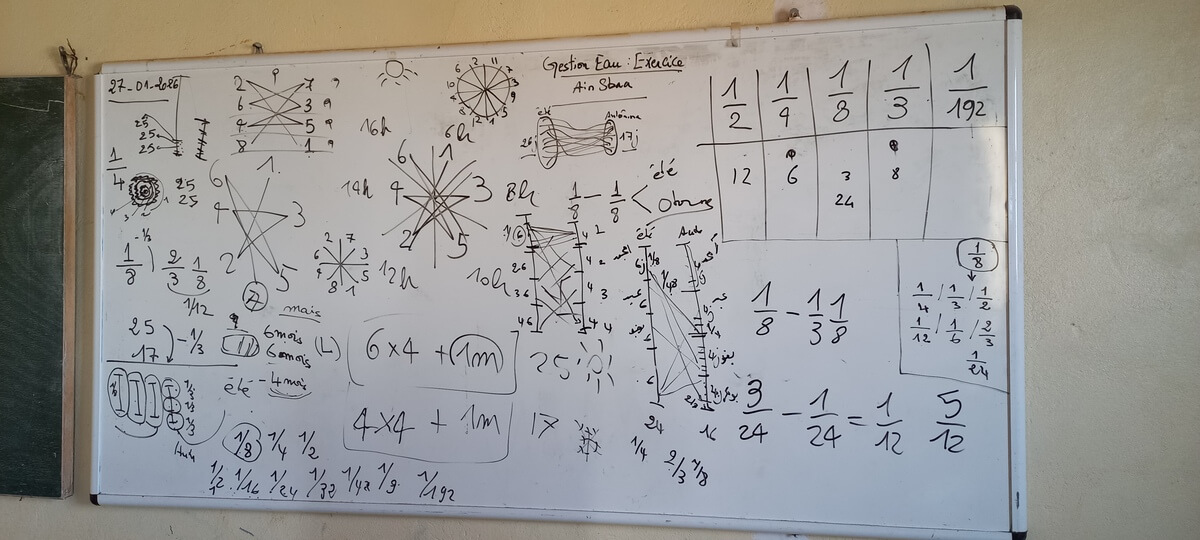
The distribution of this water is a public and highly structured affair. Each morning, a representative of the council of elders marks the water allocation for each user on a carved tree trunk, using nails to represent fractions ranging from 1/2 to 1/192.

© Association Douiret-Sbaa de Développement Local
Each share corresponds to a precise irrigation time, and the community relies on the mosque clock to ensure fairness. The first user of the day, who is also responsible for closing the reservoir the previous evening, opens the valve and carefully regulates the flow, strictly respecting each person’s allocated time.
© Association Douiret-Sbaa de Développement Local
The rhythm of this ancient system adapts to the seasons. Summer consists of 25-day cycles and autumn of 17-day cycles. Water allocations are adjusted as the seasons change, and responsibility for opening the reservoir rotates daily among the beneficiaries, by drawing lots, following a strict code of conduct that ensures fairness and order in this age-old practice.

© Association Douiret-Sbaa de Développement Local
This traditional water management system, both technical and social, is a living example of ancestral know-how. It illustrates how Mediterranean communities have developed sustainable practices, combining culture, responsibility, and the preservation of natural resources.
As part of the MedWet #CultureForWetlands campaign, this type of cultural heritage is celebrated as a treasure to be protected and passed on to future generations.
For further information, please contact:
Si Abdelkrim Boughoud, Association Douiret-Sbaa de Développement Local
boughoud1@gmail.com
Share